

The Art of Medical and Scientific Exchange: A New Model of Engagement
The goal of every medical affairs professional is to establish seamless interactions with healthcare providers (HCPs), provide meaningful value by serving as a trusted scientific expert, and cultivate long-term, peer-to-peer relationships with thought leaders. When done effectively, these interactions naturally lead to impactful insights and meaningful scientific exchange, benefiting both the organization and the broader healthcare community.
Here, we propose a powerful new model for medical affairs engagement with HCPs that extends beyond transactional data exchange. Unlike rigid, linear engagement models, this framework acknowledges the inherent uncertainty present in every HCP interaction and accounts for it through nuanced, human-centered engagement characterized by both scientific rigor and interpersonal artistry.
Introduction
We live in an era of information overload. This is especially true for physicians, who are not only focused on delivering high-quality patient care but are also confronted with the rapid expansion of therapeutic options and the continuous evolution of clinical evidence. Similarly, medical affairs professionals (e.g., Medical Science Liaisons [MSLs]) face an ever-growing volume of clinical data generated by both their own organizations and competing companies. Given this environment, a purely transactional approach to medical and scientific exchange with healthcare professionals is no longer sufficient.
Successful engagement with HCPs involves far more than simply delivering data and asking a series of predetermined questions in search of “gold-nugget” insights. Relationships with thought leaders should be viewed as a shared intellectual journey in which both parties derive value from the exchange. This model assumes that the medical affairs professional is exceptionally well prepared for each engagement. It calls for elevating medical and scientific exchange (MSE) from a set of mechanistic processes to a more expressive and interpersonal discipline centered on relational intelligence. The necessary paradigm shift is from merely delivering data to mastering the critical elements of human engagement.
Our framework, visualized here, defines MSE as an active and integrated process built upon five foundational pillars. The model assumes that the medical affairs professional is thoroughly prepared for the interaction and capable of dynamically adapting to the needs of the discussion. The central thesis of this framework is that scientific data does not merely exist—it must resonate in order to become actionable. Equally important is the recognition that the five components do not operate in a linear sequence. Rather, they remain continuously present throughout the interaction, with attention shifting dynamically among them as the conversation evolves.

Effective engaging with the thought leaders in the field is an application of a true human artistic skill.
The Five Pillars of Masterful Engagement
1. Sense & Feel: Context as the Foundation
The meeting begins long before the first question is asked. The first pillar, Sense & Feel, centers on pre-engagement awareness and an appreciation of the environment surrounding the interaction. The MSL must be able to read the room, understand the situation, and interpret the broader context quickly and accurately. This ability requires patience, practice, and continual refinement.
Paradoxically, developing this skill often requires slowing down. By slowing both physical movement and attention, we become more aware of our surroundings and are better able to perceive subtle but important details. It is essential to first understand the immediate physical space and take a moment to appreciate it. For example, is the meeting taking place in an open office where others may overhear the conversation? Are there carefully arranged flowers on the conference table? Simply taking a moment to appreciate the space—whatever form it takes—can foster attentiveness, presence, and connection.
Additional elements that fall within the Sense & Feel pillar include:
Reading the social style of the thought leader.
Appreciating their energy and state of mind (e.g., do they appear more stressed than usual?).
Assessing the urgency—or lack thereof—surrounding the discussion.
Recognizing other situational factors that may influence the interaction.
Indeed, any aspect of situational awareness belongs within the Sense & Feel pillar. Cultivating this awareness requires a calm and focused mind—one that is not fixated on any single detail while remaining receptive to everything that is perceptible in the environment.
2. Create and Maintain A Field of Resonance
If we think of scientific exchange as a dance, resonance is the music that moves the dancers. This pillar recognizes that, as the medical affairs professional, you are largely responsible for the energy and atmosphere of the interaction. Your role is not merely to participate in the exchange but to actively shape the environment and bring your best self to every single engagement. This can be achieved by several means:
I. Create Respect for Space. A key principle is becoming comfortable with moments of silence and allowing them to occur naturally. Often, this means resisting the urge to rush into complex or potentially tense discussions. Instead, allow conversations to unfold organically and at an appropriate pace.
II. Create Warmth. Everyone—including the world's leading physicians—benefits from warmth and genuine human connection. As an MSL, you have the opportunity to bring that sense of connection into the interaction. Doing so requires authentic emotional intelligence, a deep appreciation for the complexity of physicians' professional lives, empathy, and a sincere interest in their humanity. Sometimes this is as simple as offering a warm smile, maintaining a calm demeanor, and creating an atmosphere of ease and openness.
III. Don't Disrupt the Flow
Every human interaction contains an element of uncertainty. We rarely know exactly what will happen next or where the conversation will lead. Effective engagement requires embracing that uncertainty and allowing the discussion to flow naturally. This often means setting aside personal agendas (and even elements of a company's agenda to allow the exchange to develop organically rather than rigidly following predetermined checkpoints. To avoid fragmented discussions and to help ensure that the conversation remains productive, objectives and topics of interest can be aligned with the thought leader before the engagement begins. This represents a best practice for facilitating meaningful exchange while preserving conversational flow. If doing so, it is a great idea to always address the points that are important to the thought leader first on the agenda being mindful of their seriousness.
Maintain Warm Agreeableness
This may be the most important principle of all. Medical affairs professionals should strive to maintain a posture of warm agreeableness throughout every interaction. The truth is that everyone in the pharmaceutical and diagnostics industry, along with patients and staff, are all competing for physician’s time and their attention. Even if the scientific disagreements arise, it is entirely possible—and indeed necessary—to remain respectful, open-minded, and constructive while preserving the relationship in its entirety. Also it is essential to always be protective of thought leader dignity and honesty. Organizations, roles, and even therapeutic areas may change over the course of one’s career, but meaningful professional relationships should ideally endure the test of time.
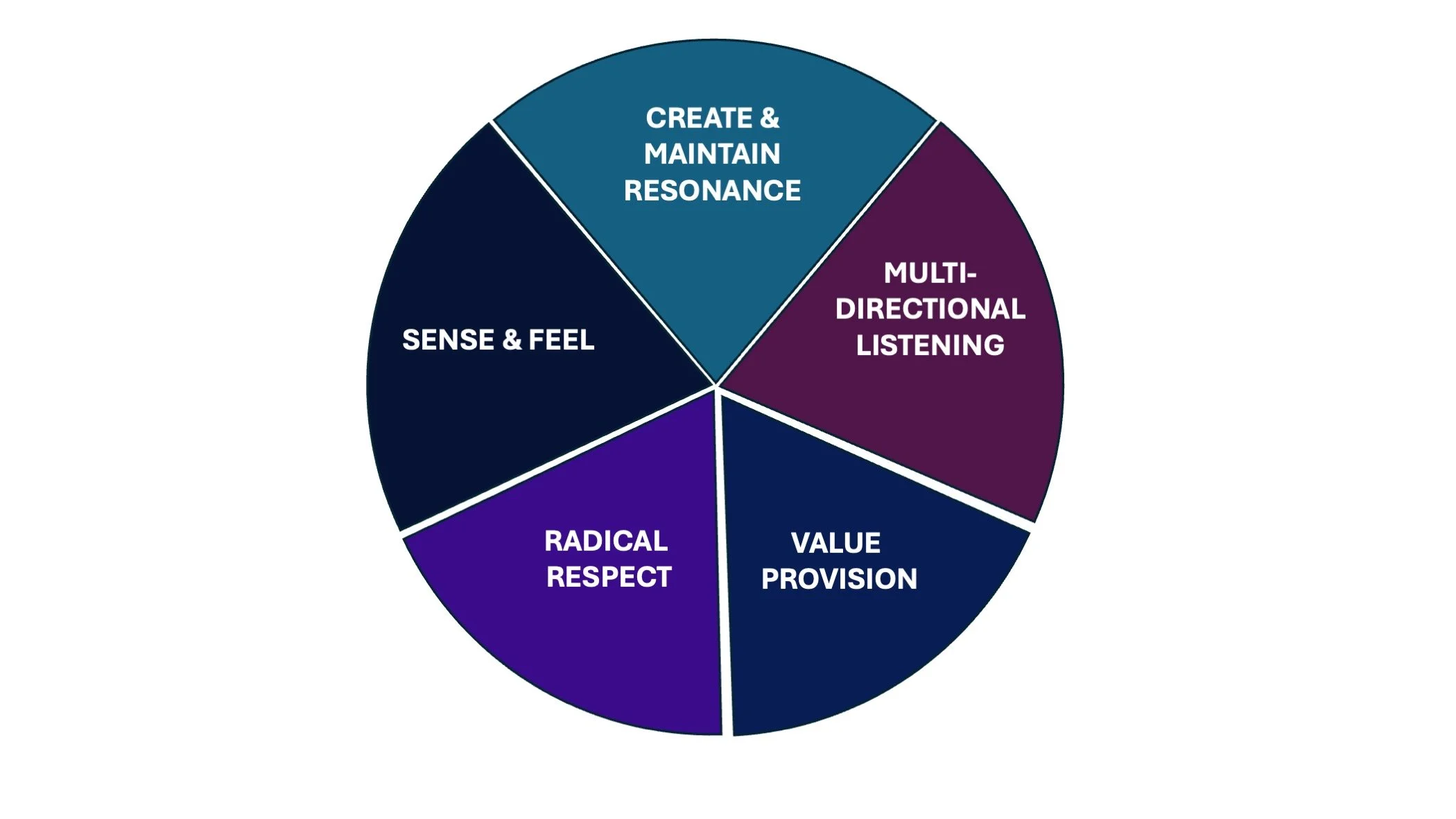
The five components do not operate in a linear sequence. They remain continuously present throughout the interaction, with attention shifting dynamically among them as the conversation evolves.
3. Multi-Directional Listening: Going Beyond Active Listening
Active listening is often described as listening attentively while waiting for an opportunity to speak. In practice, however, it can sometimes become little more than preparing a scripted response while another person is talking. This is not true listening. ‘True listening’ or multi-directional listening is an elevation of this foundational skill. It involves the simultaneous ability to direct attention toward three distinct dimensions:
Internal (The “What”). One aspect of attention is focused on the explicit information being presented.
Contextual (The “Why” and the “How”). Second aspect of attention is focused on listening for emotional tone, level of conviction, and potential underlying motivations behind the perspective being shared.
Implicit (The “What’s Unsaid”). The ability to discern subtle cues, pauses, hesitations, and omissions in order to appreciate potential gaps in knowledge, unmet needs, or strategic challenges.
This level of multi-directional listening requires genuine curiosity and an unbiased mind. It also requires the previous pillar #2 of creating and maintaining a field of resonance. Such openness allows the listener to understand not only what was said, but also the broader professional perspective from which those views emerged. Like the other pillars, this skill requires self-awareness, continual refinement, and deliberate practice. This is the sauce that the best medical insights are made with.
4. Radical Respect: A Posture of Humility and Dignity
Deep respect for the thought leader is the cornerstone of trust. This is not merely a matter of polite deference, but rather a profound form of professional respect that is both earned and reciprocated. Any resistance toward postures of radical respect toward healthcare providers requires further introspection and developing a deeper understanding of the profession and complexities of giving patient care. Contrary to what many may believe, a posture of radical respect should not be something displayed only during a one-on-one or group meeting with a thought leader. Rather, it should be a visible and enduring attitude toward the thought leader's work, their time, their expertise, and their perspectives. Medical affairs professionals that interface with external thought leaders also have the ability to advocate for their thought leaders as well as the broader professional field. Part of the medical affairs professional's role is to help elevate internal teams to this same level of appreciation. Home-office teams can sometimes become disconnected from the realities of clinical practice and the daily demands placed on physicians. It is therefore essential to serve as a bridge, helping colleagues understand and appreciate the complexity of physicians' professional lives. Your responsibility is to honor the years of dedication that brought physicians to their current position and to recognize the unique challenges they face. When interactions are grounded in genuine respect, scientific contributions are more likely to be received not as challenges or corrections, but as opportunities for partnership and collaboration.
5. Value Provision: The Artistic Execution of Insight
While the previous pillars build the vessel, the Value Provision pillar represents the true medicine within it. Once you have sensed the need, created resonance, listened deeply, and established trust, you are positioned to deliver value with precision. Value provision is not simply about sharing the latest publication or periodically discussing clinical data. Rather, it involves providing insights that directly address the specific context and needs of the individual thought leader.
This value can take many forms, including—but not limited to:
Connecting current challenges to relevant scientific literature.
Providing strategic perspectives on emerging trends observed at international congresses.
Facilitating connections with other experts or collaborators.
Helping contextualize clinical observations within the broader body of medical evidence.
Identifying gaps, opportunities, or areas for future exploration.
Providing broader large congress overviews to physicians who are unable to attend.
This pillar represents the culmination of the model. It is the moment when an interaction evolves from a conversation into a truly actionable, bilateral intellectual partnership. Finally, sometimes even a small spark along the value provision spectrum can initiate large scale collaborations, publications, and clinical studies. Examples of such stories from the field are innumerable.
Conclusion
By conceptualizing medical and scientific exchange through this artistic lens, we transform the nature of our interactions in the field. We move beyond serving merely as conduits of information and become trusted scientific peers and collaborative partners.
Operating through these five pillars enables more meaningful dialogue, deeper scientific discussions, stronger strategic partnerships, and more impactful insights. Ultimately, this approach creates value not only for physicians and healthcare systems but, most importantly, for the patients they serve.
References:
The scientific exchange model developed and the ideas originated herein are original to the best of our knowledge and were developed by Mirza Peljto, PhD and the Field Medical Center of Excellence. Once the model was developed and conceptualized, it was further reiterated in collaboration with AI platform, Gemini by Google (2026, June 24 version) [Large language model]. https://gemini.google.com/. Microsoft. (2026).
Once the fascicle was fully written, the final version was proofread by Microsoft Copilot (GPT-5-based large language model) [Large language model]. https://copilot.microsoft.com with any subsequent minor editorial changes. Microsoft Copilot was used to assist with editorial review, grammar correction, and stylistic refinement. All conceptual content, framework development, and scientific interpretations originated from the author and were independently reviewed prior to submission.