

FOUR CORE MSL COMPETENCIES
There are four core MSL competencies: adaptability, clinical acumen, relational intelligence, and resilience (work ethic). Here, we look at each of these four competencies and provide a larger framework for evaluating these by MSL managers.
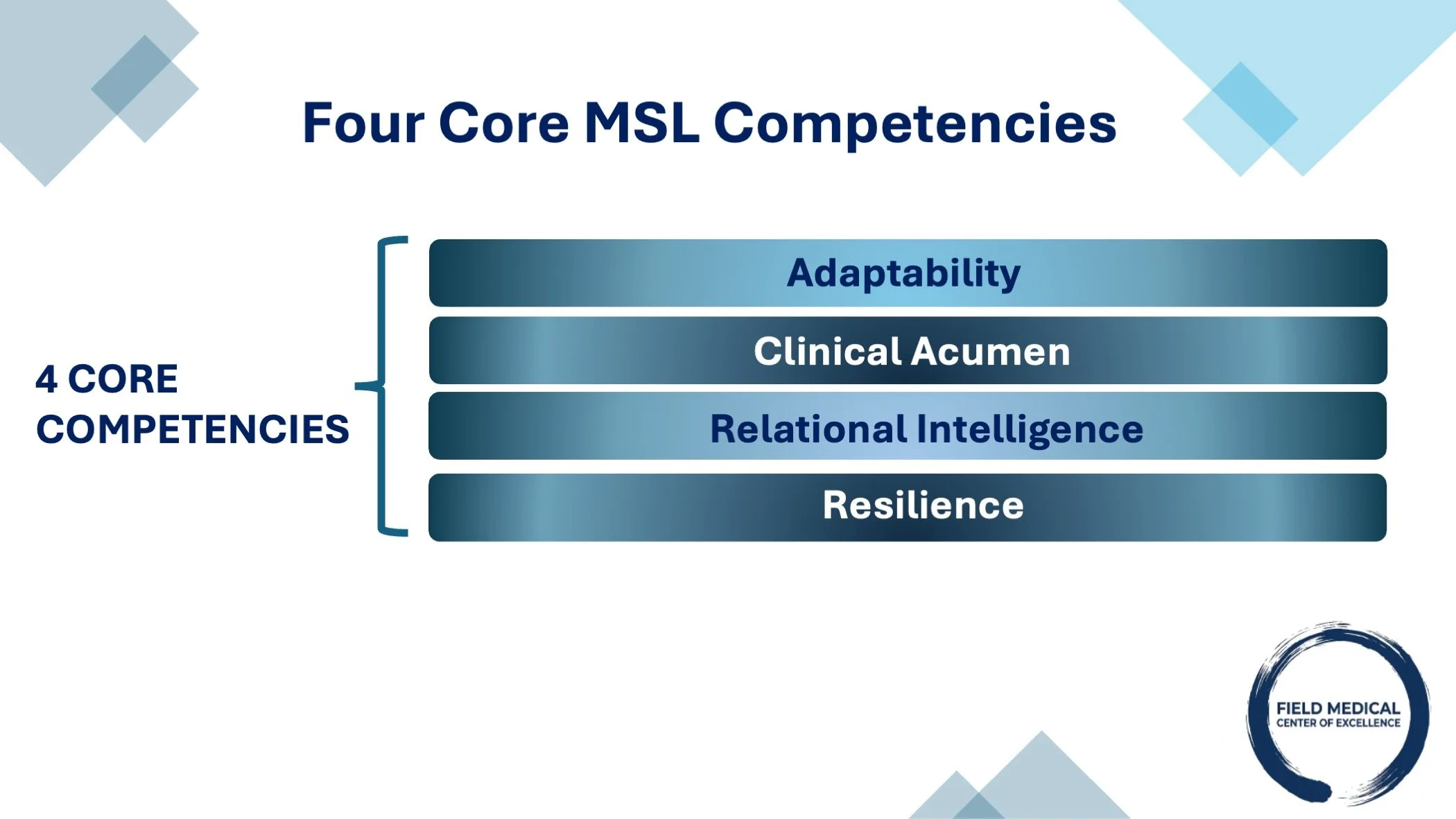
Four Core MSL Competencies
ADAPTABILITY
Being adaptable is the first of the four core competencies for Medical Science Liaisons (MSLs) to master in order to excel in their profession. Adaptability can be defined in many ways, but in the context of an MSL, a practical definition would look like this: the ability to dynamically pivot focus, execution, and communication style.
Adaptability is a key trait ensuring professional maturity, and its relevance extends far beyond the MSL role. Embodying this trait implies not only being open to diverse viewpoints and experiences but also being able to change direction ad hoc. Most importantly, along with openness and flexibility, being adaptable translates into being perceived as "easy to work with" by both external and internal stakeholders.
There are numerous examples of how adaptability serves as a demonstrated strength within Medical Affairs. For instance, a team may be supporting an upcoming medical launch, but the Phase III clinical study does not yield results positive enough to warrant a full approval. This moment requires a swift shift in both strategy and execution; being adaptable in this context benefits not only the individual contributor but the entire team.
Another clear example of adaptability specific to the MSL role is the ability to quickly adapt to the social style of a thought leader. Based on personal observations in the field, roughly 90% of MSLs struggle to do this well. Most MSLs remain in the same operational mode regardless of who they are engaging. Because these communication behaviors are highly conditioned, this is often the most difficult core competency for MSL managers to coach.
We have all faced situations where yesterday's top priority is no longer today's priority. By remaining adaptable, we are able to shift gears and focus on what matters most. Those who master this core competency are generally viewed as leaders on the team and are frequently given high-impact, high-visibility development opportunities by leadership. Ultimately, projecting calm and demonstrating adaptability not only helps the individual achieve their objectives with all stakeholders, but it also ensures the integrity of relationships and elevates the entire MSL team.
Throughout my career, I have had the privilege of leading MSLs who possessed an extraordinary capacity for adaptability. Navigating ambiguity with ease, these individuals consistently maintained a solution-oriented, optimistic mindset. Many have since ascended into leadership roles, distinguishing themselves as highly accomplished Medical Affairs executives. When looking back at their career trajectories, the mastery of adaptability was the definitive trait that set them apart.

Being adaptable is one of the core competencies of being an excellent MSL.
Manager Corner
MSLs who command a high degree of adaptability consistently manifest the following key behavioral indicators:
Pivots communication and engagement styles in real time: Accurately and efficiently diagnoses a Key Opinion Leader's (KOL) preferred data delivery format and social profile, seamlessly shifting from granular, analytical data dissection to macro-level clinical utility based on stakeholder preference.
Proactively realigns territory tactics and strategic plans: Rapidly adapts local operational management and tactical positioning when unexpected market disruptions occur—such as sudden competitor data readouts, a shifting clinical trials landscape, or altered regulatory timelines.
Demonstrates intellectual agility in response to evolving clinical paradigms: Rapidly assimilates, synthesizes, and masters complex new clinical data or therapeutic indications that fall outside of their primary comfort zone or historical area of expertise.
Models resilience and serves as a stabilizing influence: Projects a solution-oriented, anchoring presence across both internal cross-functional groups and external teams during periods of organizational restructuring, territory realignments, or sudden strategic shifts in a product launch lifecycle.

Clinical acumen is a core MSL competency.
CLINICAL ACUMEN
When building new teams as a hiring manager, I interviewed a high volume of candidates across the entire US territory. As a young manager, I took a chance on a few MSLs fresh from graduate studies or with minimal experience directly relevant to the MSL role. While they possessed other strong core competencies, they initially lacked deep clinical acumen. However, over time, a remarkable transformation occurred: these individuals became the "unicorns" of my team. They began to outperform more seasoned MSLs across every available metric, including the quality of field insights, stakeholder engagement, internal collaboration, and overall volume of meaningful interactions.
So, what exactly is clinical acumen, and how should we define it? In the field, practical, dynamic definitions are often more helpful than rigid ones. Clinical acumen is far more than just "knowing the data." It is the core competency that allows an MSL to seamlessly translate medical evidence into clinically impactful insights, establishing peer-to-peer credibility with thought leaders and ultimately improving patient healthcare.
To fully understand this competency, we can break it down into three distinct dimensions:
Total Therapeutic Area Literacy
The first aspect of clinical acumen goes beyond knowledge of individual products or a single company’s pipeline; it requires total therapeutic area literacy. In other words, an MSL must become an expert in the entire disease state, not just their own company's molecules. For example, an MSL needs to thoroughly understand the underlying pathophysiology, the historical evolution of the standard of care, and the mechanisms of action of competitor pipelines. While a low-acumen MSL may simply quote their product’s prescribing information, a high-acumen MSL discuss how new data fits into the broader, real-world treatment paradigm.
Methodological Fluency & Critical Evaluation
Second, high clinical acumen demands that an MSL critically evaluate emerging data and maintain complete methodological fluency regarding clinical trials. An MSL must possess a deep understanding of trial design, clinical endpoints, statistical analysis, and post-approval real-world evidence (RWE). This fluency matters immensely because Key Opinion Leaders (KOLs) do not want slide decks simply read to them; they want to debate the underlying trial methodology. When an MSL can seamlessly discuss hazard ratios, confidence intervals, or patient baseline characteristics, their peer-to-peer credibility skyrockets.
Answering the "So What?" Question
Third, an MSL must be able to efficiently and convincingly answer the definitive "so what?" question. They must readily address the unspoken query every clinician has: "How does this study change the way I treat the patient sitting in front of me tomorrow morning?" Answering this requires a sophisticated understanding of the real-world implications of clinical data, specifically regarding:
Understanding patient segmentation.
Identifying which patient populations stand to benefit most from the data.
Recognizing which patient segments may be at a higher risk for adverse effects.
Cultivating Acumen at Medical Congresses
One of the most effective ways for MSLs to develop and maintain their clinical acumen is through active engagement during high-impact medical congresses. Unfortunately, many MSLs—and even their managers—fail to fully engage when attending these events, often treating them as passive obligations. To truly build acumen, it is vital for an MSL to intentionally attend scientific sessions and congress presentations that extend well beyond their own company-sponsored data, allowing them to absorb competitive updates and broader therapeutic trends firsthand.
Manager Corner
MSLs who command a high degree of clinical acumen consistently manifest the following key behavioral indicators:
Critically appraises peer-reviewed literature to identify subtle clinical nuances, emerging data gaps, and safety considerations.
Formulates balanced, scientifically rigorous responses to complex, unsolicited off-label inquiries from healthcare providers.
Proactively monitors and synthesizes competitive data, pipeline developments, and shifting clinical guidelines.
Delivers high-impact presentations that masterfully contextualize complex clinical data for both internal and external stakeholders.
Serves as an authoritative therapeutic area resource, providing strategic scientific expertise to immediate peers and home office colleagues alike.
RELATIONAL INTELLIGENCE
The volume of external and internal stakeholders an MSL engages with is exceptionally high compared to almost any other role in the pharmaceutical industry. Relational Intelligence (RQ) is the capacity to compliantly navigate, build, and sustain complex, long-term, peer-to-peer relationships across these diverse stakeholder ecosystems. This core competency requires the deliberate application of interpersonal insight, strategic empathy, and communication agility to establish deep, mutually beneficial partnerships with healthcare providers, researchers, and internal cross-functional colleagues. Ultimately, Relational Intelligence is the definitive skill that transforms transactional field interactions into sustained, trusted scientific collaborations.
To understand its operational value, Relational Intelligence can be broken down into distinct layers that demonstrate why it is a master-level skill:
1. Navigating Complex Dynamics and High-Profile Personalities with Top-Tier KOLs
MSLs consistently interface with world-renowned experts, department chairs, and principal investigators who sit at the very pinnacle of their respective fields. High-RQ MSLs successfully engage with these high-profile personalities and strong egos without becoming intimidated or overly sycophantic. This requires a grounded professional confidence. When executed correctly, the dynamic shifts from a passive, unidirectional presentation to an active, peer-to-peer partnership focused on solving complex clinical challenges.
Furthermore, an MSL with a high degree of Relational Intelligence uncovers exactly what an individual Key Opinion Leader (KOL) values. While one investigator may be driven by abstract publications and clinical trial design, another physician might be deeply focused on community health equity and patient access. Relational Intelligence centers on identifying these unique drivers and tailoring the scientific relationship around them.
2. Understanding the Broader KOL and Institutional Ecosystem
Comprehending the overarching framework of hospital systems, how physicians deliver care within their clinics, and the vital roles of supporting staff (such as mid-level providers and clinic coordinators) directly amplifies an MSL's field effectiveness. This systemic awareness translates into how seamlessly an MSL manages the timing and cadence of their communications. A relationally intelligent MSL respects the context of major medical congresses, a KOL’s clinical schedule, and their preferred channels of engagement. Treating both KOLs and their clinical staff with the utmost professional respect within their patient-facing environments is foundational.
Every medical institution operates under distinct logistical parameters. From navigating physical clinic spaces to understanding the nuances of how and when to schedule an interaction, an MSL must remain highly attentive to institutional details. Remaining keen on these subtle nuances ensures smooth, compliant engagement with an individual site or KOL. Utilizing a digitized framework or CRM platform to document these institutional preferences ensures not only continuity of institutional knowledge, but also a seamless, premium experience for the stakeholder over time.
3. Mastering the "Social Styles"
This point connects directly back to Adaptability as a core competency. As previously highlighted, the vast majority of MSLs struggle to adapt to the distinct social styles of thought leaders. An MSL with high Relational Intelligence can quickly diagnose a stakeholder's communication preferences.
While social styles are traditionally categorized into specific profiles—analytical, driver, amiable, and expressive—the reality is that most KOLs display a fluid mix of these traits depending heavily on the clinical or professional context. An MSL must possess the agility to adapt to these nuances in real time to ensure high engagement during an interaction. This capability sits at the intersection of Relational Intelligence and the MSL's broader emotional quotient (EQ).
4. Managing Internal Stakeholders
Just as an MSL must drive meaningful value for external KOLs, achieving excellence in the role requires delivering equal value to an ever-changing landscape of internal stakeholders. An MSL must effectively navigate and manage partnerships across internal, cross-functional boundaries, including Clinical Operations, Commercial teams, Home Office Medical Affairs, and Translational Medicine.
Equipped with high Relational Intelligence, an MSL seamlessly bridges the external and internal environments. They ensure that compliant field insights are effectively communicated back to the organization while skillfully advocating for their territory's strategic needs without causing cross-functional friction. Ultimately, these individuals serve as trusted enterprise partners both inside and outside the company walls.
The Transactional vs. Relational MSL
We can fundamentally categorize MSLs into two distinct groups based on their level of Relational Intelligence: the "Transactional" MSL and the "Relational" MSL.

Relational MSLs have deep relationships in the field.
The Transactional MSL operates on a checklist mentality. They secure a meeting, deliver a standard slide deck, document the interaction in the CRM system to check a box, and essentially disappear until the next major data readout.
The Relational MSL treats the relationship as a continuous scientific dialogue. They remember a specific clinical challenge a KOL mentioned six months prior, proactively and compliantly follow up with a newly published independent study, and maintain a sustained partnership built on ongoing scientific exchange.
Manager Corner
MSLs who command a high degree of Relational Intelligence consistently manifest the following observable behaviors in the field:
Seamlessly decodes and adapts to the diverse social styles, personalities, and operational constraints presented by both external and internal stakeholders.
Cultivates deep, peer-to-peer relationships and robust scientific partnerships anchored in mutual trust, objective data exchange, and long-term strategic value creation.
RESILIENCE (WORK ETHIC)
Exceptional Medical Science Liaisons (MSLs) possess the operational stamina and emotional resilience needed to thrive in a highly autonomous environment, navigate frequent rejection, and sustain high performance despite the physical and mental demands of extensive travel. The MSL role is widely regarded as one of the most challenging—yet rewarding—positions within the biopharmaceutical industry. As such, resilience and work ethic are foundational competencies that enable MSLs to remain self-motivated, disciplined, and strategically focused without requiring constant managerial oversight.
Several key pillars define resilience and work ethic within the MSL profession.
1. Navigating Autonomy
A defining characteristic of the MSL role is the significant degree of independence it affords. In many respects, an MSL serves as the CEO of their territory. Unlike many corporate functions, there is no manager directing day-to-day activities or closely monitoring how time is allocated. High-performing MSLs recognize that this autonomy is a privilege that demands accountability and self-discipline.
These individuals develop and execute thoughtful territory plans, optimize their schedules, and leverage time between engagements productively. They proactively identify, map, and cultivate new stakeholder relationships while continuously advancing strategic objectives. In contrast, a weak work ethic in a highly autonomous environment often manifests as passive territory management, excessive reliance on direction from others, and limited initiative in identifying opportunities for meaningful engagement.
2. Managing Rejection Effectively
Rejection is an inherent aspect of field medical work. As physicians and key opinion leaders (KOLs) face competing demands on their time, engagement opportunities are not always readily available. Rejection can take many forms, including unanswered outreach emails, cancelled meetings, shortened discussions due to patient care responsibilities, or prolonged periods of limited responsiveness.
Field medical professionals routinely encounter these small but persistent setbacks. Resilient MSLs understand that such situations are rarely personal. They remain mindful that physicians' primary responsibility is patient care—not interaction with industry representatives. Rather than becoming discouraged, they adapt their engagement strategies, refine their outreach approaches, and identify alternative, compliant ways to deliver value to stakeholders. Their perseverance enables them to maintain momentum and continue building meaningful professional relationships over time.
3. Managing the Physical and Mental Demands of Travel
For many MSLs, field-based responsibilities require spending more than 70% of working time traveling. This may include individual KOL engagements, regional and national meetings, weekend conference coverage, and week-long congresses. While territory size varies, travel remains a central component of the profession.
The burden can be especially significant in large territories, such as those frequently found in the Western United States. Extensive travel often involves overnight hotel stays, frequent dining on the road, long-distance driving, delayed flights, missed connections, late hotel check-ins, changing time zones, and extended periods away from home. Over time, these challenges can place considerable strain on both physical and mental well-being.
Resilience in this context means maintaining intellectual preparedness, professional presence, and strategic focus despite fatigue and disruption. High-performing MSLs are deliberate in managing their energy and personal well-being. They consistently demonstrate enthusiasm, scientific credibility, and composure, whether engaging with a community physician or presenting to academic leaders and department chairs immediately after a demanding travel day.
Conversely, MSLs with lower levels of resilience and work ethic often view travel challenges and rejection as obstacles that diminish motivation. Their fatigue becomes visible in stakeholder interactions, and they tend to react to circumstances rather than proactively manage their territories.
By contrast, highly resilient MSLs serve as Strategic Field Anchors. They view autonomy, rejection, and travel as variables to be managed rather than barriers to success. They maintain a consistently professional presence with internal and external stakeholders, use setbacks as opportunities to refine their approach, and maximize productivity even during travel disruptions. For example, flight delays may become opportunities to review literature, prepare for upcoming engagements, or address strategic territory needs.
Manager Corner
MSLs who demonstrate strong resilience and work ethic commonly exhibit the following behaviors:
Consistently execute strategic territory plans and proactively engage KOLs with minimal managerial oversight.
Respond to rejection by adapting engagement strategies while maintaining motivation, professionalism, and persistence.
Effectively manage personal energy and well-being, maintaining poise, credibility, and productivity across all internal and external stakeholder interactions.
Demonstrate accountability, ownership, and self-discipline in a highly autonomous working environment.
Remain focused on long-term territory objectives despite operational challenges, travel demands, or temporary setbacks.

Having resilience and strong work ethic are key to having a successful career as an MSL.