
VALUE
About a year into my first MSL role, I experienced a defining moment while sitting with a cup of coffee. A simple thought surfaced that would eventually become my field mantra:
“It's all about the KOL.”
At the time, the phrase felt as though it captured my entire philosophy as an MSL. On the surface, it may sound like a reminder to accommodate KOL preferences, communication styles, and demanding schedules. While those elements certainly matter, the meaning runs much deeper.
As I continued to reflect on this principle, I came to realize that it represents a fundamentally value-based approach to the MSL role. Respecting preferences is the baseline. The real question is how we can create meaningful value for the physician and, ultimately, for their patients. This mindset is reflected in questions such as:
· What does this KOL need to better serve their patients?
· Are there clinical trials that may be relevant to their interests or patient population?
· What are their scientific and research interests, and how might those align with the company's translational or clinical research priorities?
Questions like these help uncover not only what a KOL truly needs, but also how an MSL can best support them. The goal shifts from simply conducting interactions to becoming a trusted partner who provides meaningful scientific value.
Learning how to create value during in-person or virtual meetings takes time. It requires developing an understanding of individual KOLs while simultaneously refining one's broader MSL skill set. Over time, an appreciation also develops for the diversity of KOL types and needs.
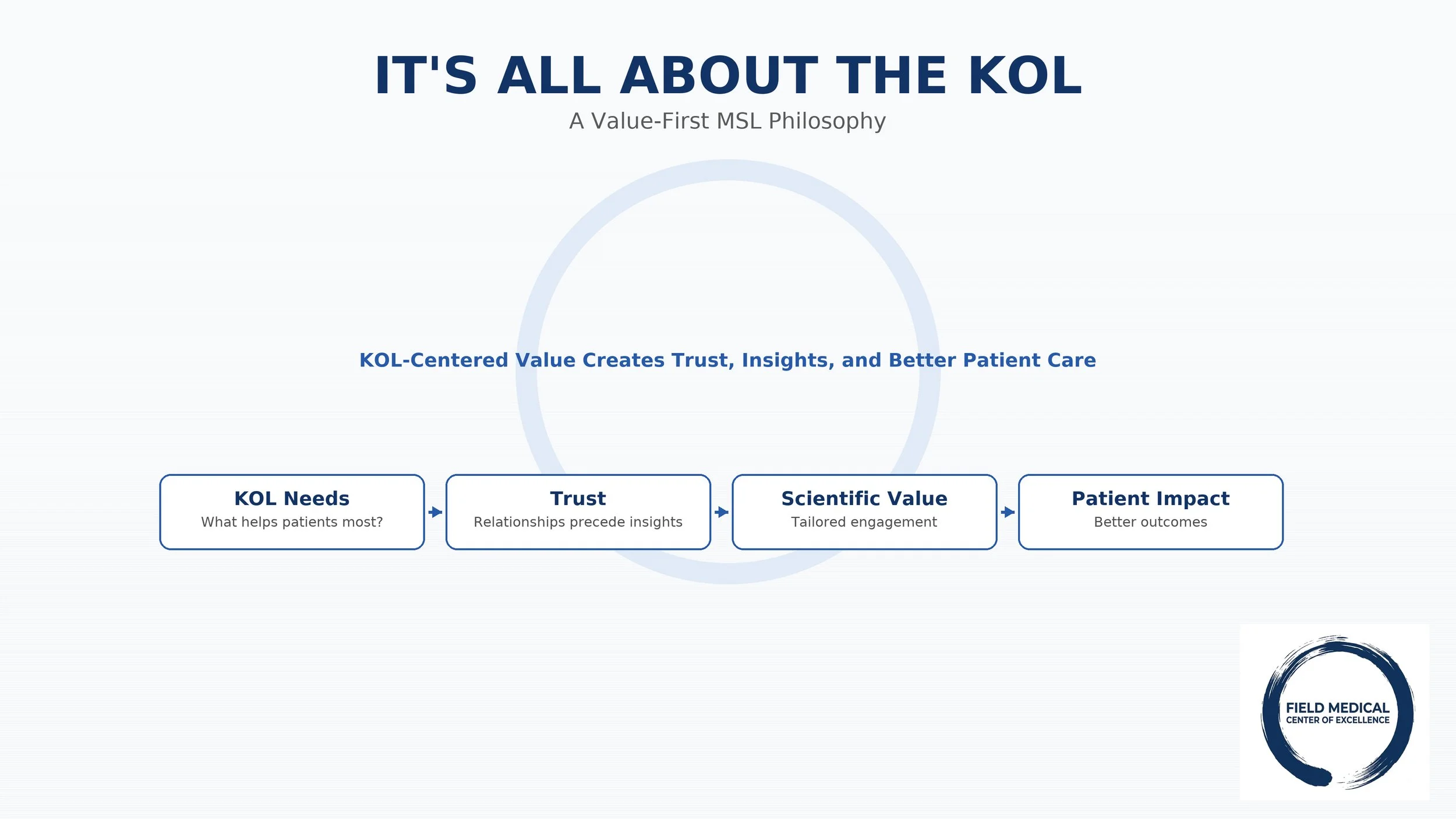
“It’s all about the KOL”
For example, internationally recognized thought leaders often require little education regarding mechanisms of action or pivotal clinical trial data. Their interests may instead center on early-phase development programs, emerging scientific hypotheses, investigator-sponsored research (ISR), or strategic discussions about the future direction of a therapeutic area. These experts also serve as invaluable sources of insight regarding the current treatment landscape, evolving standards of care, and interpretations of newly released datasets.
In contrast, community-based providers may have different needs. They are often deeply focused on patient care and may have less time to stay abreast of every scientific advancement. In these situations, education itself can become one of the most valuable services an MSL provides.
In many ways, great MSLs can be evaluated similarly to great people managers. The best managers serve their teams according to individual needs and preferences. Likewise, the most effective MSLs serve their KOLs according to what those KOLs need most. Value-focused MSLs consistently place KOL needs at the center of their interactions. Practically, this begins by understanding the KOL's agenda and concerns before introducing your own. Reviewing and agreeing upon meeting objectives at the outset can transform an interaction from a routine exchange into a meaningful and productive discussion. When KOL priorities drive the conversation, the meeting naturally becomes more valuable.
This perspective is especially important because physicians are extraordinarily busy. They simply do not have time for interactions that offer little value. At the same time, physician burnout remains one of the greatest challenges facing modern medicine (Guille and Sen, 2024). Most physicians spend their days directly caring for patients or supporting critical patient care functions. Their time is precious.

MSLs who are value-centric tend to have the strongest relationships with their thought leaders.
A value-minded MSL recognizes this reality. Meetings are not scheduled merely to satisfy internal metrics or check a box. Sometimes a discussion may focus entirely on a KOL's questions or concerns, with little attention given to the originally planned company agenda. To some individuals within the home office, this may seem inefficient or even counterproductive. It may not generate the anticipated insights or advance a specific strategic objective. One could even argue that the MSL is not maximizing the potential of the interaction from a company perspective.
But is that really the case? My experience suggests otherwise. Relationships precede insights. Without strong relationships, even the best questions may yield limited or unreliable information. Conversely, when relationships are built on trust, openness, and mutual respect, the quality and depth of insights improve dramatically. In this sense, the strength of the relationship determines the value of everything that follows. That is why the principle of “It's all about the KOL” matters. It allows the MSL to temporarily set aside personal objectives and focus on what is most important to the physician.
The rationale is simple. As MSLs, we do not directly treat patients. Physicians do. Even those who are not patient-facing, such as pathologists or radiologists, play essential roles in the delivery of care. Therefore, by helping KOLs succeed in serving their patients, MSLs can indirectly influence patient outcomes in the most meaningful way possible. There is also an element of selflessness in this approach. Supporting a KOL's needs requires setting aside personal preferences and, at times, even organizational priorities in favor of what creates the greatest value for the physician. The unique aspect of the MSL role is that this service-oriented mindset often generates a ripple effect. By helping one physician provide better care, an MSL may ultimately contribute to improved outcomes for countless patients.
Some may argue that value must flow in both directions. The KOL should benefit from the interaction, but the company and the MSL should also gain insights and strategic value in return. That is certainly true. Yet there is an interesting paradox in field medical. The most meaningful insights often emerge naturally when they are not the primary objective. When genuine value creation becomes the mission and when the interaction is truly centered on the KOL, trust deepens, relationships strengthen, and insights flow organically. In the end, value returns to the MSL and the organization precisely because, from the very beginning, it was all about the KOL.
References:
Guille C, Sen S. Burnout, Depression, and Diminished Well-Being among Physicians. N Engl J Med. 2024 Oct 24;391(16):1519-1527. doi: 10.1056/NEJMra2302878. PMID: 39442042. (https://www.nejm.org/doi/full/10.1056/NEJMra2302878)
Note on use of AI:
Values fascicle was creatively developed based on professional experience and the ideas described herein are original to the best of our knowledge. All ideas were developed by Mirza Peljto, PhD and the Field Medical Center of Excellence. Once the ideas were developed, initial text was produced by Dr. Mirza Peljto. Once the original fascicle was fully written, the final version was proofread by Microsoft Copilot (GPT-5-based large language model) [Large language model]. https://copilot.microsoft.com Microsoft (2026) with any subsequent minor editorial changes. The meaning of the original text was fully retained. Microsoft Copilot was used to assist with editorial review, grammar correction, and stylistic refinement. All conceptual content, framework development, and scientific interpretations originated from the author and were independently reviewed prior to publication.